
Monday 8th September 10 am
For those going on to Hobart we will continue our reminiscences of John Ward Gleadow and Diana Harriet Kearton’s arrival in Van Diemen’s Land in 1825 on the actual day of their first landfall 200 years ago. We will start with a short walk of about 600 m in Hobart before driving on to Birch’s Bay. The walk should only take about 45 Min.
Starting Point: Our walk will start outside the main doors to St David’s Cathedral in Murray St, near the intersection with Macquarie St.
Starting Time: We will start our walk at 10 am, so please be there 5-10 minutes before this.
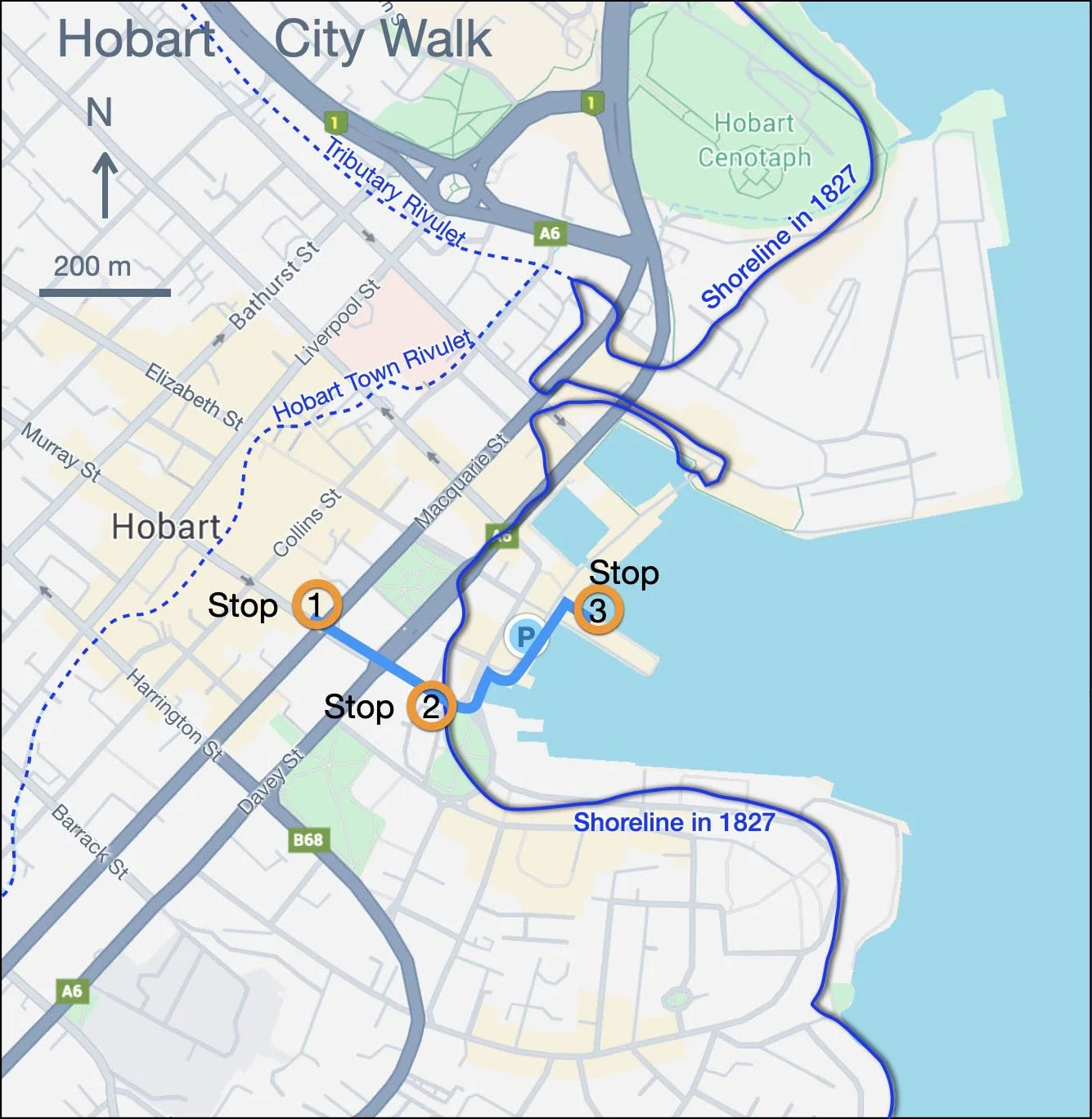
Route: We will follow the route shown on the map with three stops as detailed below.
Parking: Parking is available along the docks area as shown, accessible from Elizabeth St.
Hobart Short walk
-
Our first stop is outside St David’s Anglican Cathedral on the corner of Murray and Macquarie Streets in Hobart. The first church on this site, St David’s Church, was built between 1817 and 1823 and it was here that John Ward Gleadow and Diana Harriet Kearton were married on 3rd April 1826. They were married by the Rev William Bedford who was then Chaplain of the settlement. The first Bishop of Tasmania was appointed in 1842, whereupon the church became St Davids Cathedral, later replaced by the present building, for which construction started in 1868. The original Church with its spire can be seen clearly in the early painting of Hobart Town by JC Souter from 1825 used on the Homepage.
There were three witnesses to Diana and John’s marriage listed on their marriage certificate – Eliza Bradley, and John and Ann Eddie, who had been fellow passengers on the Andromeda the year before. John and Ann also moved to Launceston, where John became an auctioneer, often selling properties for which John Ward Gleadow was doing the conveyancing. Interestingly Diana’s surname is written on the marriage certificate as ‘Keaston’, which along with ‘Kirton’ was one of the common alternative spellings of her surname.
There was nothing but a grassy slope between the church and the shoreline, which was much closer to St David’s then before land reclamation works along the shore started in 1832. The blue line shows the position of the shore on an early map from 1827. The first docks were built in stages between 1830 and 1894, changing the shoreline completely to what we see today. There were no docks when John and Diana arrived in the Andromeda on 11 September 1825 so the ship would have anchored offshore and they would all have gone ashore by boat.
-
This building was first built in 1840 to be the Customs House for the growing port. The building was designed by the colonial architect John Lee Archer in 1830 and the site was originally right on the waterfront, before land reclamation work started and the docks were built. Construction of this building started with convict labour in 1835 and was ready for the Customs Department from 1 September 1840. Stone for the Building was quarried locally along Salamanca Place and the Queens Domain from where a small railway was built to move the stone to the construction site. The original non-elected Legislative Council, initially a group of 6 people appointed by the Lieutenant Governor, met in the ‘Long Room’ inside the Customs House for the first time on 19th June 1841, after moving from the original Government House about where Franklin Square is now.
In 1851, the old nominated Legislative Council was replaced by a more democratic Council where two thirds of the members were elected. John Ward Gleadow was elected in unopposed as the member for Cornwall as was his friend Richard Dry who became the first Speaker of this newly expanded Council. They both stood on a platform of opposing convict transportation. Initially there were no prescribed terms for members and John served from 1851 to 1855, when he resigned. John Ward Gleadow, with Dicky Dry and others, achieved their aim of ending transportation in 1853, after less than three years. He also served on the committee which drafted a new Constitution for Tasmania that provided for self government by an entirely elected bicameral (Two house) Parliament. This was given royal assent by Queen Victoria on 31 October 1854 and Tasmania was the first of any of the colonies to have its own Constitution.
After these major achievements in the early 1850s John, who had never sought political office, resigned from the Legislative Council in 1855 and did not immediately stand again for Parliament under the new constitution. However in 1866 he was persuaded to stand for the new lower house and was elected to the House of Assembly as the member for Morven (now Evandale) later that year. The new Lower house also met in this building after is was altered in 1856 and expanded again in 1938-1940. Extensive renovations since 1998 have restored the external appearance of the building to its original condition, much the same as it was when John Ward Gleadow served here.
-
This replica of the early 19th Century sailing ship the Lady Nelson is about half the length and width of the Andromeda which brought John Ward Gleadow and Diana Harriet Kearton from England to Van Diemen’s Land in 1825. The Lady Nelson was very important in the early history of Van Diemen’s Land. Most significantly this included bringing the first settlers from Sydney to found the colony in early 1803 and later that same year to relocate the settlement from the abandoned outpost on Port Phillip Bay, at what is now Sorrento, to Hobart under Colonel David Collins. Collins became the first Lieutenant Governor of the new colony at Hobart Town, initially administered from New South Wales. The following year in 1804 the vessel was also used, with two other ships, to found the first settlement in northern Tasmania on the Tamar.
The Lady Nelson was about half the size of Andromeda that brought John Ward Gleadow and Diana Kearton to Hobart in 1825 and gives an idea of how hardy the early colonists were to make the long voyage all the way from England in such tiny vessels.