
John Ward Gleadow’s Launceston
Saturday 6th September at 10 am
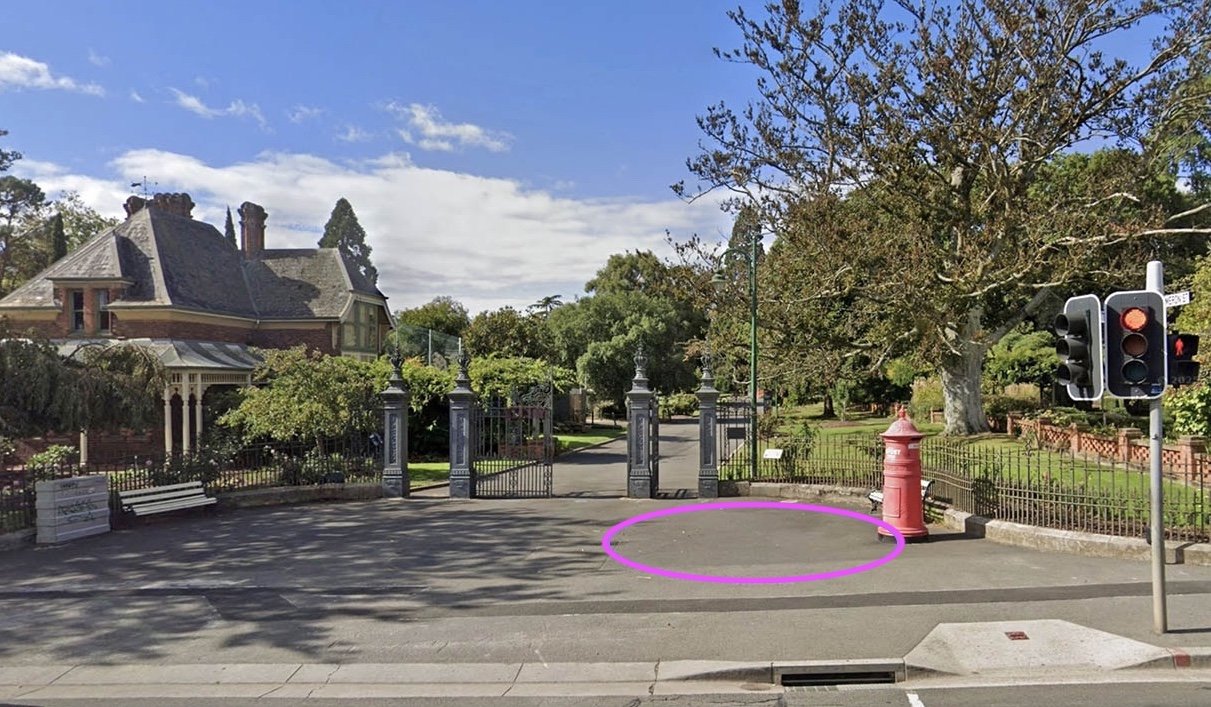
Starting Point: Our walk will start here, near the red letter box, just outside the gates of City Park in Tamar St, opposite Cameron St.
Starting Time: The walk will start at 10 am on Saturday 6th September. Please be there at least 5 mins before.
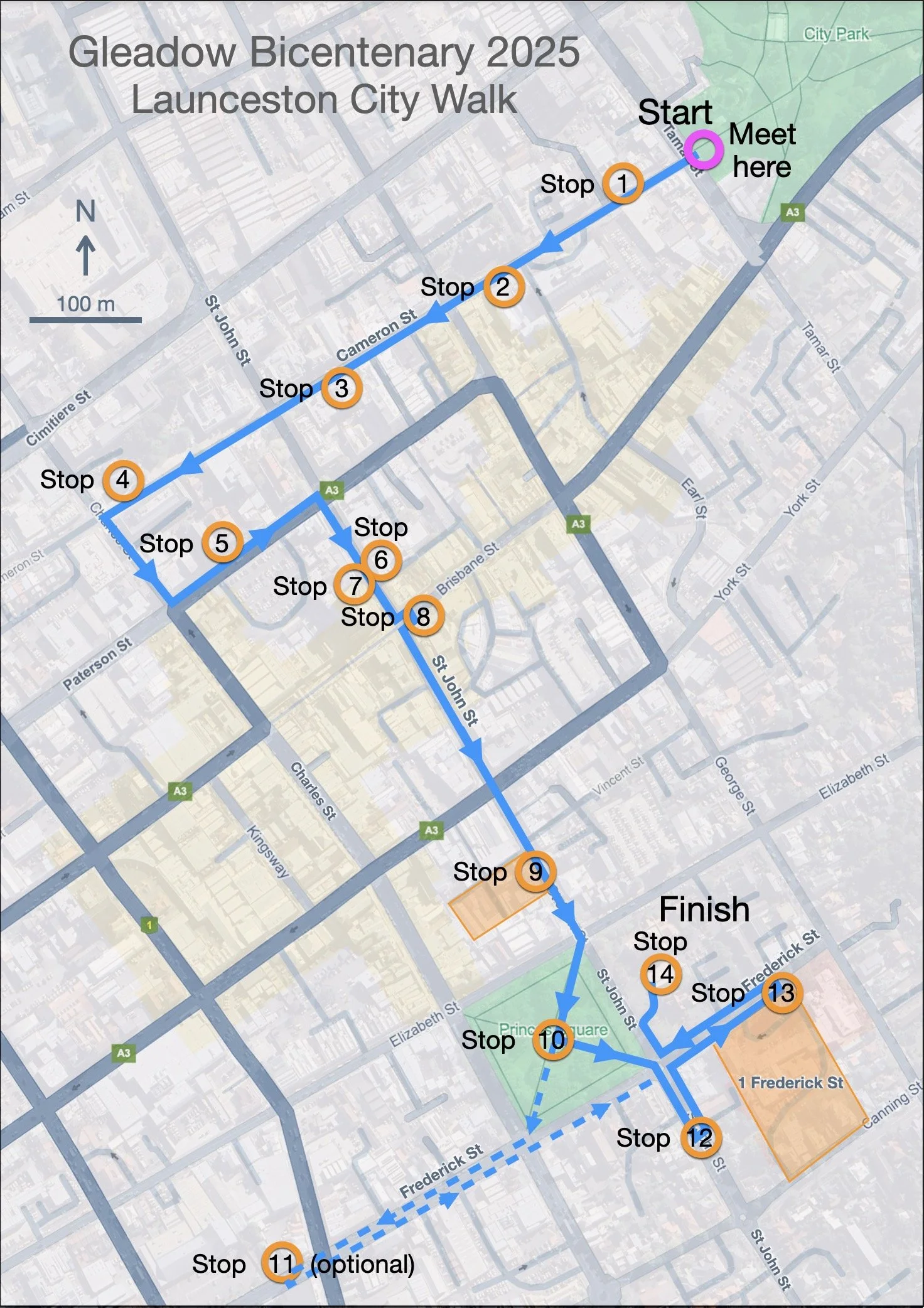
Route: We will follow the route on the map and visit a number of places of importance in the lives of John Ward and Diana Harriet Gleadow.
The walk is about 2 km long from beginning to end, and should take about 60-90 min to complete.
There is a stop by stop guide below that you can access from a smart phone on the day, and a downloadable illustrated PDF version below.
Launceston City Walk Itinerary
-
Meet just before 10 am, outside the gates to City Park on Tamar St, right opposite the end of Cameron St. City Park was established in the 1820s by the Launceston Horticultural Society and handed over to the Launceston City Council in 1863.
-
This relatively modern building at 12 Cameron is the latest location of the law form founded by John Ward Gleadow in 1826, one of the two oldest continually operating law firms in Australia. The firm moved to this site on Cameron St in 1989.
The firm is now Jason Parker Legal but until 2023 it was Ritchie & Parker, Arthur Green and Co. (RPAG), formerly Gleadow, Ritchie and Parker until John Ward Gleadow’s retirement in 1869 when it became Ritchie & Parker. In 1913 they merged with another law firm, Arthur Green and Co. to become RPAG. Mary Louise Gleadow, John Ward Gleadow’s great granddaughter, worked for RPAG her whole adult life until her retirement in the 1970s.
-
The Cornwall Hotel was founded in 1824 by John Pascoe Fawkner. In the early days of the colony, hotels were often the only places with large enough rooms where meetings could be held. In 1834 both Fawkner and John Batman had meetings here to plan their two separate expeditions to establish a settlement on Port Phillip Bay, now Melbourne, often regarded as Launceston’s ‘most successful start-up’. Two important meetings took place here that concern John Ward Gleadow and at which he was present.
A meeting here in 1850 led to the establishment of the Anti-Transportation League in Launceston, which resolved to stop the transportation of convicts to Van Diemen’s Land. John Ward Gleadow and his then parliamentary colleague Richard (later Sir Richard) Dry were both members of the League, and actively supported this cause as Members of the Legislative Council, including drafting a petition to Queen Victoria. Just three years later in 1853 transportation of convicts was finally stopped.
Although it was disbanded after transportation was stopped, the influence of the Anti-Transportation League was widespread. It was an important spur to the growing movement towards political independence in the colonies over the next few decades. The national flags of both Australia and New Zealand were inspired by the flag of the Anti-Transportation League.
Another widely advertised public meeting was held at the Cornwall Hotel on 27 February 1851 to form a committee to “secure the return of John Ward Gleadow as member for Launceston” in the first ever elections to be held in Tasmania later that year. Similar plans were afoot to get Richard Dry, formerly a nominated member, elected. In the end, by agreement between the two groups, he was elected for Launceston and John Ward Gleadow was elected unopposed as the member for Cornwall.
-
The Northern Club at 61 Cameron St was founded in 1894 and John Ward Gleadow’s grandson, George Dalrymple Gleadow, was one of its founding members. Based on the ‘Gentlemen’s Clubs’ of London it was a place where businessmen, civic leaders and professionals could meet and relax or share a drink or meal. Such places were vital for networking in those days. The first meeting of the Northern Club was held at the old International Hotel in Brisbane St on 12 March 1894 and members ship grew to over 100 in its first year. The club finally closed its doors in 1996 after more than a century of operation due to declining membership and revenues.
This building had originally been the home of the Manager of the National Bank of Tasmania, located next door at 63-65 Cameron St until the bank moved to new premises in 1888 (Stop 7). The building was initially leased in 1898 and then bought from the bank in October 1902. George Dalrymple Gleadow worked for the National Bank of Tasmania where he would soon after become General Manager in 1898, a position he held for 27 years. The front of the Northern Club was modified by adding verandahs in 1905 and the present frontage was renovated again in 1937.
-
Macquarie House at 92 Cameron St, now Civic Square, was built in 1830 as a warehouse and store by John Ward Gleadow’s great friend Henry Reed, grandfather of Sir Hudson Fysh, founder of Qantas. Reed had arrived in Hobart in 1827 and walked to Launceston where he took a job in John Ward Gleadow’s store for three yers until 1829. The two were around the same age and became good friends. Henry decided to branch out on his own in 1829 and did extremely well for himself, as this large building constructed only a year later shows. It was the first four story building in Launceston.
Henry converted to Methodism in early 1834 and was responsible for John’s similar conversion later that same year. John Ward Gleadow and Henry Reed with several other prominent citizens were involved in many important works that have left their mark on the developing city to this day. The two expeditions of John Batman and John Pascoe Fawkner to the Port Phillip District, which established the new settlement of Melbourne in 1835, were both supplied with provisions from this warehouse and Reed also gave Batman a loan of £3,000 to support his expedition. This building was inappropriately named Macquarie House in the 1920s after the early NSW Governor Lachlan Macquarie, who, although he visited Launceston once, held a very poor opinion of the early settlement.
-
The first Methodist chapel in Launceston was built in 1826 where Holy Trinity Anglican Church is now located in Cameron St, opposite the Cornwall Hotel. The Gleadow and Reed families became very active members of this congregation after 1834. As numbers grew, larger premises were needed and this land on Paterson St was granted to Methodists by Governor Arthur in 1835. The building on the right is the first Chapel and schoolroom designed by Samuel Jackson and built in 1835-1836 and was the main church building for 30 years, later becoming the church hall.
At about this time in 1835, John Ward Gleadow became Secretary, and Henry Reed the Superintendent, of the Sunday School. Sunday Schools in those days were as much about providing basic education as they were about teaching the Christian faith. This association began a lifelong interest in public education in both men. Soon afterwards Henry Reed took over the Margaret St school and John Ward Gleadow became Superintendent of the Paterson St school . The school flourished under his administration and John continued in this role for about 30 years until his accident in 1868 forced him to step down from active service, but even then he remained associated with this office until he died.
The foundation stone for the main church was laid in September 1866 and the building was opened in February 1868. The two buildings show the progression from a more classical style of many chapels in the Regency era to the gothic revival trend which became dominant during the 19th Century. This church was designed by the Melbourne architectural firm, Crouch and Wilson and largely funded by Henry Reed, even though he was now living in England, for an extended period. John Ward Gleadow was also heavily involved in the project.
-
John Ward Gleadow’s original law practice had many partnerships over the years. William Henty joined the firm as Gleadow & Henty from 1837 until her retired from the practice in the late 1840s. During this time the firm operated from the Gleadow’s St John St Property (Stop 9). In 1848 John and Diana’s eldest son Robert Gleadow competed his articles and joined the firm as Gleadow & Son which continued until Robert was tragically drowned in the North Esk River in December 1859.
After that John Ward Gleadow took William Ritchie and Robert Parker into the firm as Gleadow, Ritchie & Parker from 1862. Following John Ward Gleadow’s retirement from the practice about 1869, the firm became Ritchie and Parker and relocated to this location, 81 St John St. Ritchie and Parker’s sons also joined the firm and in 1913 they merged with another law firm to become Ritchie & Parker, Arthur Green & Co. (RPAG) in 1913. The expanded firm continued to operate from this address until it moved to 10 Cameron St in 1989. Most of the work carried out by this firm since it was founded by John Ward Gleadow has been in conveyancing.
-
The grand Victorian building at 50 St John Street, was built in 1888 to house the old National Bank of Tasmania Ltd. which had been established in Launceston in 1885 originally at 63-65 Cameron St next to the Northern Club. The National Bank was formed out of restructuring of the Bank of Tasmania which was in financial difficulties at that time. John Ward Gleadow’s grandson, George Dalrymple Gleadow (1863-1926), had started work for the Bank of Tasmania in 1880 at age 17 and worked his way up through the ranks until he became Chief Manager in 1898, a position he retained after the bank was taken over by the Commercial Bank of Australia in 1918 until his retirement due to ill health in November 1925. Sadly he died a few months later on 23 January 1926 of an aortic aneurism at the age of 62. The old National bank building was one of the grandest in Launceston in its day. The CBA was headquartered in Collins St Melbourne and later merged with the Bank of NSW in 1982 to become Westpac, one of the ‘big four’ banks in Australia today.
-
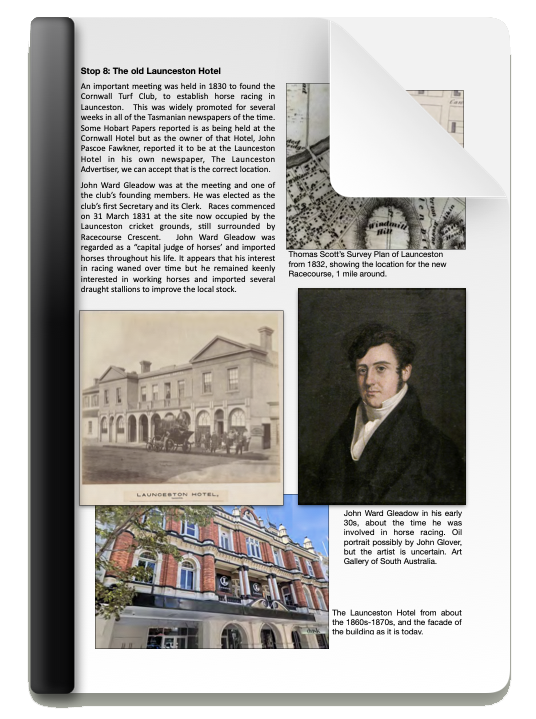
An important meeting was held in 1830 to found the Cornwall Turf Club , to establish horse racing in Launceston. This was widely promoted for several weeks in all of the Tasmanian newspapers of the time. Some Hobart Papers reported is as being held at the Cornwall Hotel but as the owner of that Hotel, John Pascoe Fawkner, reported it to be at the Launceston Hotel in his own newspaper, The Launceston Advertiser, we can accept that is the correct location.
John Ward Gleadow was at the meeting and one of the club’s founding members. He was elected as the club’s first Secretary and its Clerk. Races commenced on 31 March 1831 at the site now occupied by the Launceston cricket grounds, still surrounded by Racecourse Crescent. John Ward Gleadow was regarded as a “capital judge of horses’ and imported horses throughout his life. It appears that his interest in racing waned over time but he remained keenly interested in working horses and imported several draught stallions to improve the local stock.
-
This site, extending from 116-124 St John St today, was where John Ward and Diana Gleadow first made their home in Launceston. They originally lived in a cottage here at the top end of the property, near 124 and beside what became the Jewish Synagogue in 1844. John also first operated his legal practice, the first in northern Tasmania, from their cottage. Later, possibly in 1829, as the business grew, a separate building was built on the property to house the growing legal business. This new building, possibly at 116 St John St, was the office of the law firm as it became Gleadow & Henty, and later Gleadow & Son, on this site from about 1829. Old maps from 1835 show several buildings on this site mostly near to the St John St frontage with a large open garden area in the middle of the block probably where they grew vegetables and fruits, as well as being a pleasant garden to enjoy.
Soon after they started living here, Diana was home alone when she had the frightening experience of being visited by bushrangers. But she escaped out of a back window and ran and hid in the bush at the back of their property near where Charles St is today. It was a very different place then to the one they helped create together over the next 55 years. John Ward Gleadow also had a store to sell the goods that he had brought with him from England, and doubtless more that he imported later. We do not know where the store was but most likely it was also on this very generous block on St John St. This was the store in which Henry Reed worked from 1827 to 1829.
-
Princes Square was originally known as St John’s Square, because the clay for the bricks to build St John’s Anglican church was quarried from this site. It was then used for a many different purposes including a rubbish dump, a military parade ground, the hanging go two bushrangers, somewhere for kids to play cricket and even the attempted launch of a hot air balloon.
The Square was fenced and planted in 1858 and a French-made bronze fountain was acquired after it had first been exhibited at the Paris Industrial Exhibition of 1855. A half-naked nymph on the fountain was objected to by the locals and was replaced by a pineapple! The beautiful new Square was opened in November 1859, very close to the Gleadows’ Frederick St property, where they were living by then. Some early photos of the new Square show a row of tall gum trees growing along the southern boundary of their block at 1 Frederick St. The square was renamed Princes Square in 1868 to celebrate the visit of His Royal Highness the Duke of Edinburgh. I am sure the Gleadow family often visited and appreciated this beautiful local park.
The square was also an important space for outdoor political meetings, especially around the growing opposition to convict transportation during the 1840s and 50s. Launceston was the major centre of anti-transportation feeling and this became an important issue for John Ward Gleadow and his family, especially after he was elected to the Legislative Council in 1851. When transportation was finally abolished, a major public meeting was held here in Princes Square on 10th August 1853 to ‘adopt an address’ expressing gratitude to Queen Victoria, and “those members of Parliament and others who have been conspicuous in promoting the cessation of transportation”. The list of prominent citizens calling the meeting included Diana and John’s son, Robert Gleadow, John’s former legal partner William Henty, and also Theodore Bartley, whose daughter, Emma Matilda Bartley, would marry John Ward Gleadow’s second son, George Thomas Gleadow, in 1858.
-
Launceston Infants School at 56 Frederick St was built by a committee of prominent Launceston Citizens including John Ward Gleadow, Henry Reed, Phillip Oakden and the Rev Henry Dowling, who were often associated together in various important civic works in the early history of Launceston. This block of land was located and bought by JWG and Henry Reed on 27 January 1835 for 120 Guineas, and and they also had accepted builder John Anderson Brown’s tender of £564 to construct the school. The School was opened the following year in 1836 and initially had an enrolment of 11 children which quickly grew to 60. By March 1837, over 100 students were enrolled. This was the first public school for children in Launceston and was also used as a meeting hall and a chapel on different occasions.
The building has been owned by the Launceston City Council for many years and is soon to be restored and re-purposed as the Launceston History Centre which will make thousands of important local books, documents and research materials available for public access.
-
In the early afternoon on Monday 14th September 1868, John Ward Gleadow had a very serious accident here in St John Street which was reported in detail in the Launceston and Hobart papers, as he was a Member of the House of Assembly in the Tasmanian Parliament at the time. He had left by the back entrance to their Frederick St Home in a buggy with his son Henry Sinclair Gleadow with the intention of visiting the property Talisker. As they turned left into St John St, the horse bolted and the buggy overturned throwing them both out onto the road. John was driving– presumably sitting on the right as was customary – and was thrown violently against the curbing outside Wheedon’s shop on the opposite side of the road, sustaining severe head and other injuries. Henry escaped without injury and helped carry his father back into their home on a stretcher, where he lay on his bed unconscious for many hours.
He was visited soon after by three doctors who considered his condition ‘very unfavourable’ during the afternoon. He was still unconscious when they returned for a further consultation at 7 pm that evening, although they thought his condition slightly improved. He eventually regained consciousness later that evening, but they still considered him in great danger. The accident cast ‘quite a gloom over Launceston’ and widespread sympathy was expressed to the family. He was 76 at the time but in due course he recovered, although the effects of the accident stayed with him for the five years until he died in 1881. One consequence was that he soon resigned his position as a member of Parliament. There is a report in one of his obituaries that he suffered another similar accident some time afterwards, although this is not confirmed by any other sources.
-
The large property at 1 Frederick St was acquired by John Ward Gleadow sometime before 1844, when it is shown under his name on an old survey plan. The property is also shown in HWH Smythe’s Plan of Launceston from 1835 which shows remarkable detail of both the Frederick St and St John St properties. The Frederick St property shows a large house in the centre of the block, which extended though to Canning St, and the outlines of the driveways, paths, garden beds and trees. Also shown on the plan is the ‘back entrance’ out to St John Street, the site of his major accident in 1868. It is not yet clear exactly when the Gleadow family moved to Frederick St from their original home on St John St, but we do know that both John and Diana died there in 1881, she after a long illness on 26th August and he just 4 days later of heart failure on 25th August. They had been devoted to each other and were married for 55 years.
The 1 Frederick St property was the home to four generations of Gleadows, the last being George Dalrymple and Jessie Louise Gleadow’s children: Mary Louise, John Charles Dalrymple, Robert Bartley, Gordon Ward and Henry Dalrymple Gleadow, who all grew up here. They mostly lived at home until the boys all enlisted in the early years of World War 2. Their widowed mother, Jessie Louise Gleadow, lived on at 1 Frederick St, until she passed away on 8th February 1944. Lou, as she was known, had remarried Captain Frederick Arthur Hare, the retired Commissioner of Police for Western Australia, on 30 April 1930 and they lived at 1 Federick St until he died suddenly on 14 April 1932, just two years later, at the age of 79.
After Lou’s death the property was sold and is now part of the Charity St Vincents Hospital, which expanded from an earlier private Hospital, St Margaret’s, on the corner of St John & Frederick Streets, to now occupy most of the block. The only remnant of the original Gleadow property is the wrought iron fence along the Frederick Street frontage.
-
St Johns Anglican Church, opposite the north-eastern corner of Prince’s Square is the oldest and most important church in northern Tasmania, although services were held earlier and elsewhere before Governor Arthur laid the foundation stone for the original church here in 1824. Services were held in the incomplete church at the end of the following year, and the old church was not completed until 1830. Convicts would also attend church services standing in chains in upstairs in the gallery, up until 1835 when a chapel was built for them within the prison. The free people sat downstairs, paying 5-15 shillings per year to rent one of the pews. In 1837 the clock with just one dial facing north towards the city was installed, with other faces being added later. At the turn of the twentieth century, Launceston architect Alexander North was commissioned to design a major new church which largely replaced the original church building from 1901-1911. The new church in red brick merges with the only remaining section of the original convict-built church which is the end of the building facing St John Street, which includes the original bell and clock tower.
Within the church there is a memorial to ‘John Ward Gleadow and all his descendants’ in the form of a carved wooden prayer desk donated by one of his daughters, Emily Susannah Martin who died in South Yarra in Melbourne in 1918. The inscription reads “To the Glory of God and in memory of the Gleadow family”. Originally, the Gleadow family in the late 1820s were part of the St John’s parish, and probably part of the congregation here, before their conversion to Methodism in 1834. John Ward Gleadow’s family back in Hull were part of the Church of England there, some being buried in the Hull Minster. Over the years it seems that some later Gleadows in Launceston drifted back towards the Anglican church, judging from baptismal and other records.